Douglas Fir–an Imposter?

Did Hawaiians use Douglas Fir for their war canoes?

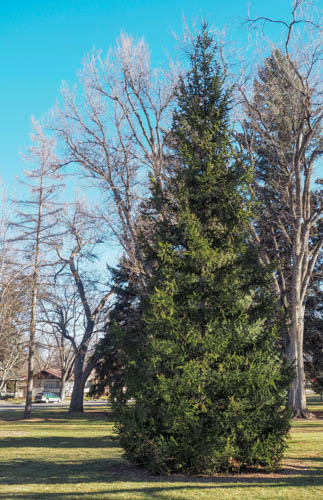
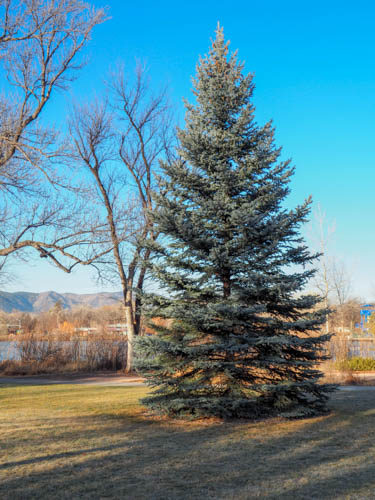
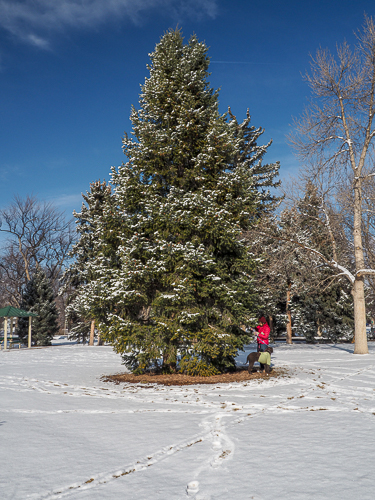
The Douglas Fir is possibly the most majestic of the trees native to Colorado and Larimer County.
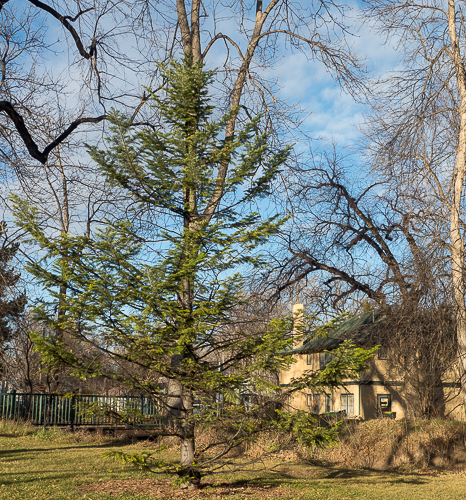
P1010479
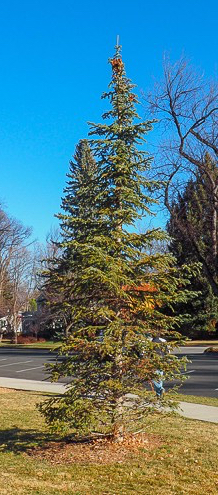
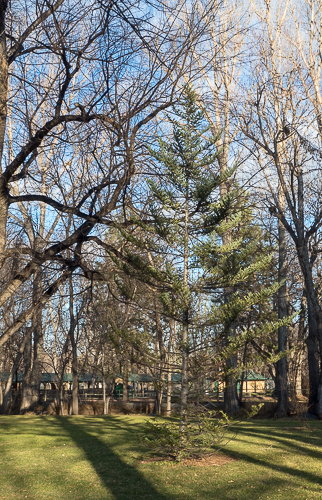
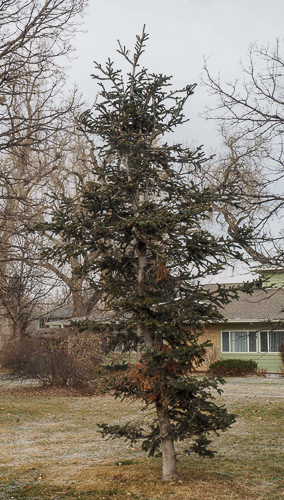
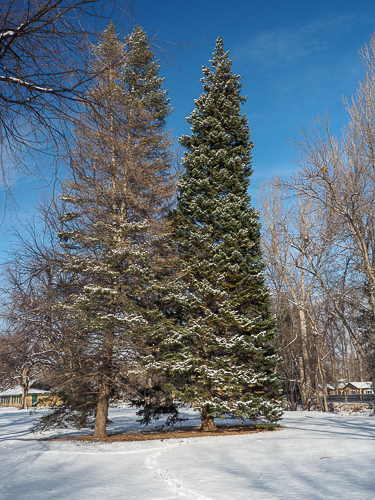
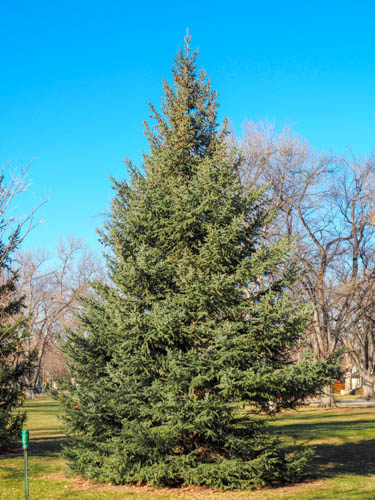
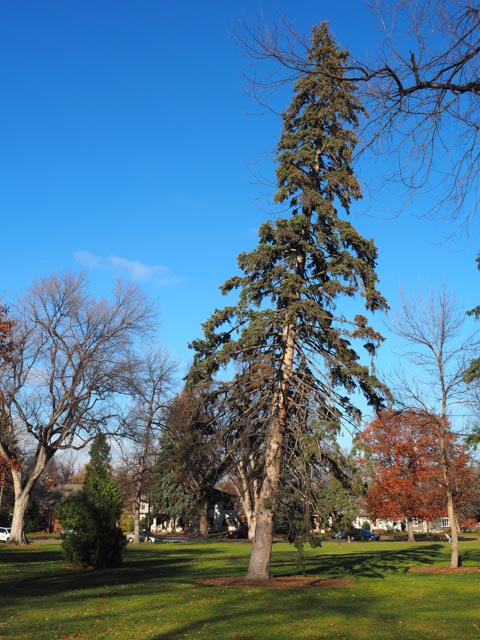
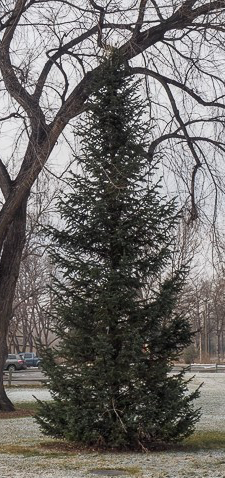
The tagged Douglas Fir in City Park

Considering only conifers, in height in North America this species is second only to the Coastal Redwood. The tallest tree is listed at over 326 feet. Doug Firs are also listed as some of the oldest trees on the continent, with one recorded to be over 1300 years. Of course both the largest, tallest, and oldest of the trees are members of the West Coast Douglas Firs, which some consider a separate species than the Rocky Mountain Douglas Fir. Others list them as geographic varieties. (National Audubon Society Field Guide to North American Trees, Western Region, 1994; North American Trees, 5th Edition 2002.) Apparently the USDA does not distinguish between the two as the range map includes both the west coast and the Rocky Mountains.

In Colorado, the champion Douglas Fir, (Pseudotsuga menziesii) is in the San Juan National Forest. The tallest in the state was measured in 2014 at a height of 169″.

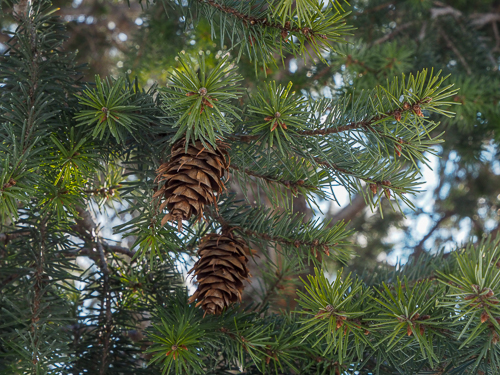
To add to the confusion surrounding this tree, it really isn’t a fir at all and has its own genus, Pseudotsuga. Some authors explain this is because it more closely resembles a hemlock while having traits of both spruces and firs. Most notably, the cones of the tree grow downward and not upward as do those of true firs.
P1010483
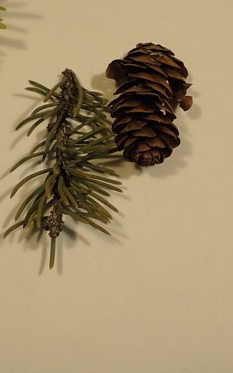
Douglas Fir cone

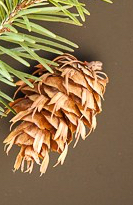
The cones are distinctive with their fringy ends and have their own legend on how they got to look that way!P1030518


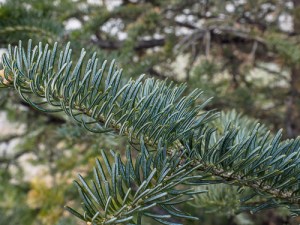
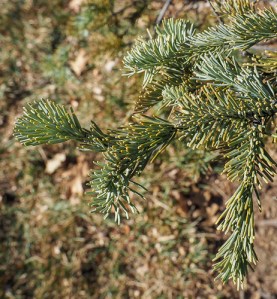
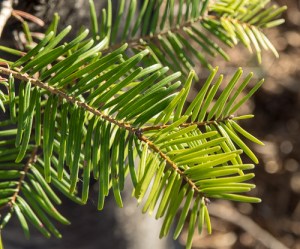
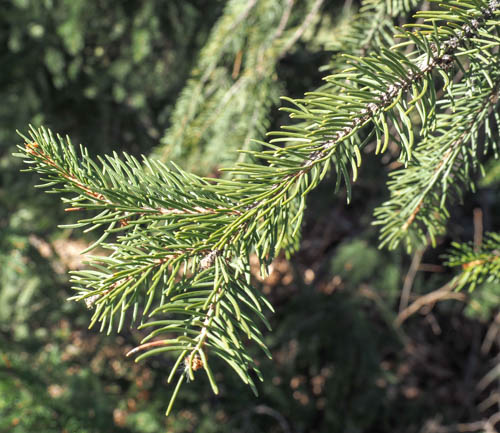
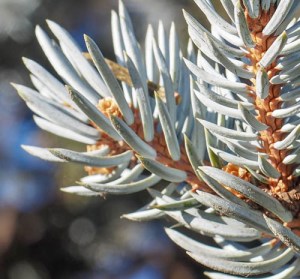
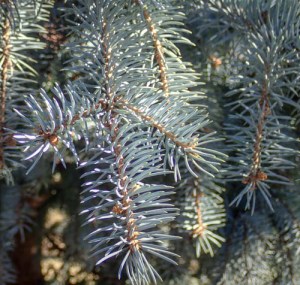
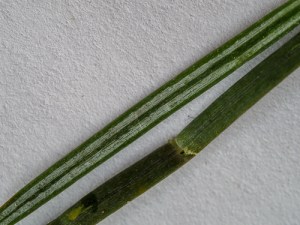
Like the true firs (Abies), needles are flat.
P1030528
Flat needles with white stripes

This species is one of the most important trees in the western forest. Many animals use parts for food. Along with the usual medicinal uses of the leaves, bark, etc to treat various aliments, including coughs and colds, spring buds were used by at least one tribe to cure venereal disease. Parts of the tree were also ground to be used as a fertilizer. Like many other members of Pinaceae, smaller Douglas fir may make excellent and popular Christmas trees.  Although the parts of the fir might not be a routine ingredient of the current American diet, the leaves can be used as a flavoring agent. A number of recipes can be found here and here. There is even a recipe for Gummy Treats.

Not only is the Douglas Fir important commercially in North America, but according to an article in WOOD magazine.com it has “migrated” to Europe, Australian, and even South Africa! Some of its commercial uses have included telephone poles, railroad ties, flooring, and paneling. The doors and most of the molding in my 1919 home are made of Douglas fir, and likely this same wood is seen in many west coast Craftsman homes. You could say this is continuing a tradition from ancient Puebloans, as they used the trees to construct their dwellings. Other uses included prayer sticks and a resin to coat buckets. The lumber is also used in boats, with the masts of the USS Constitution currently being constructed of it. The bark has been used to make a dye.

Probably one of the most surprising uses of the wood is that, even though these trees  are not native to Hawaii, this was a preferred wood for Hawaiians to construct their canoes! Probably from logs that drifted ashore.

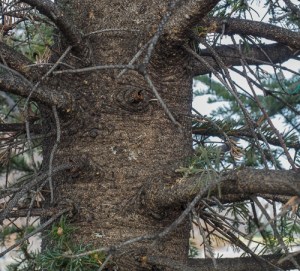
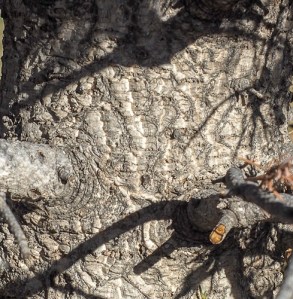
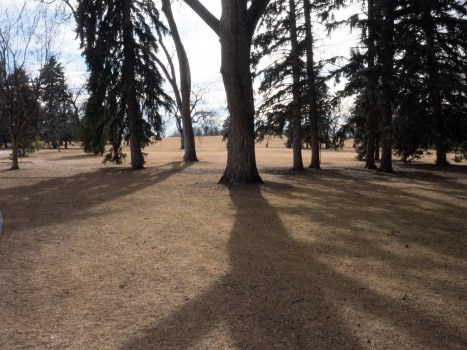
The tagged Douglas Fir (Pseudotsuga menziesii) in City Park is D196. To find this tree, head to the Northeast end of Sheldon Lake. You can park along Sheldon Drive or along the section of City Park Drive that is near the pool entrance. If you have been studying the Engelmann Spruce (D193) or Baker Blue Spruce (D194), you need only to climb up the short embankment through the tall conifers. No matter from which direction you approach this tree, if you see the huge green frogs (more Art in Public Places?) you are getting close. The Douglas Fir is south and east of the monstrosities. Depending if you are walking on the sidewalk that encircles the lake, or approaching from the street, the tree is either behind the swinging bench or in front of it.
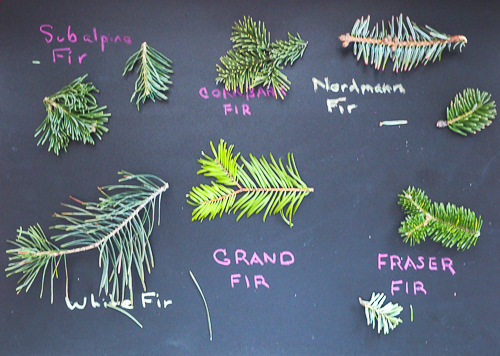


All the Firs Whose Tags You See

The cones and needles may be the clues to telling firs from spruces.

Many years ago I went on a ranger talk in a national park and have always remembered the meme “Friendly fir, prickly pine.” A lot of good that does when it comes to spruce, although a landscape architect friend added “spikey” for spruce. After running my hands over the leaves of some of the firs, though, I don’t think that learning aid is completely accurate. Many firs and spruce look disconcertingly similar. The Norway spruce, Picae abies, even shares part of its name with the firs, whose genus is Abies. One way to tell a spruce from a fir is the direction in which the cones grow. Usually trees with cones pointing up are firs. The needles on firs are also flat compared to those of spruces. In the photo below, all the pieces, except the White Fir, lie flat on the background. In the case of the subalpine, the Nordmann, and the Fraser fir, the backside of the needles can be seen to be of a lighter color, too.

P1010508
The needles on the six tagged Abies trees in the park. What looks like stray marks are actually the needles, showing how flat and thin individual ones are.

There are six identified true firs in City Park. Of these, the Subalpine, Corkbark, and White Fir are native to Colorado.

PC300407
Subalpine Fir

Subalpine fir (Abies lasciocarpa) ranges over the western half of the continent. It is also native to Larimer County (Flora of Colorado, Jennifer Ackerfield, 2015.) The tree itself is useful in watersheds and rehabilitating the land. Various parts of the tree were of use to Native Americans as shingles, bedding, and medicinally. This species normally does not produce cones until it is twenty or more years old. Most of the Colorado state champion subalpine fir are found in the San Juan National Forest. The oldest trees, including one found in Wyoming, are around 500 years old. The tallest measure over 172 feet.

PC300402
Leaves of the subalpine fir.
PC300406
Trunk of subalpine fir.

The Corkbark (Abies lasiocarpa var. arizonica) is a variant of the subalpine fir found only in Colorado, New Mexico and Arizona. It does not produce cones until it is over fifty years of age. Trees can be found on Wolf Creek Pass and in the mountains of northern New Mexico, although the champion tree has been listed variously as in Arizona or near Ruidoso, NM.  Its wood is the lightest of American trees and has little value as lumber.

PC200317
Corkbark Fir
PC200315
The trunk of the Corkbark Fir is very white
PC200316
A branch of the Corkbark Fir


Grand Firs are native to the Northwest. The layout of the needles on this conifer seem to be the flattest of the firs in the park and have an almost fernlike appearance. The trees take 200-250 years to mature and are grown for Christmas trees in this country and for lumber in Europe. Native Americans used the needles medicinally, as well as for a baby powder and a cure for baldness. The essential oils of firs have many uses including as a stimulate, deodorant, expectorant, and air freshener.

PB280107
The Grand Fir near the ditch
PB280102
Grand Fir leaves

The Fraser Fir is found in limited areas of the American south. Due to its remoteness and small distribution, its primary use is in watershed management. It is also grown commercially for Christmas trees. Sources list various types of trees as the best/most popular for Christmas; the Fraser fir is usually toward the top of the list. Fir varieties have been used for the Capitol Christmas tree fifteen times.

PB280086
Fraser Fir .


The Nordmann Fir (Abies nordmannia) is native to Asia Minor, where it is a popular Christmas tree.

PC300398
Nordmann Fir

The last of the six firs mapped in the park is the White Fir, (Abies concolor) although the tag could not be located. As can be seen on the mat with the needles above, this tree does not look that much like the other firs in the park. Its leaves are 2-3″ in length and it doesn’t lie as flat, although the individual needles are so flat they seem one dimensional!

The white fir is seen throughout most of the west and, according to the USDA map, is also native to Maine and Massachusetts. The US Forest Service distinguishes between a California white fir and a Rocky Mountain white fir. On conifers.org, another writer says white fir may be a catch-all name and that the species may have geographical variations.  The Forest Service mentions the trees can live between three and four hundred years. It is of significant use for wildlife, is used for Christmas trees, some smaller construction projects, and for food containers as its wood has little odor.

Yosemite boasts the largest white firs of the California branch of the species. The tallest tree in the Rocky Mountain group can be seen in the Hermosa Creek area of the San Juan mountains, the same area of the tall Colorado Blue Spruce.

P1010488
White Fir on the right.

Locating the Firs: All but one of the tagged firs are on the west side of the park, west of the ditch. It is probably most advantageous to park near the pool or in the ballpark lot. If you are walking, you could start at either end. The directions below are from the ballpark parking lot.

Nordmann Fir (Abies nordmannia) E41 This fir is located between the Fort Collins Housing Authority, 1715 W. Mountain, the building at the far N end of the ballpark parking lot, and the N baseball diamond. It is the only evergreen tree planted by itself in this spot.

Grand Fir (Abies grandis) E31 From the south section of the parking lot, walk between the the restrooms and the office building. The Grand fir is the evergreen just past the pedestrian bridge over the ditch that runs along S. Bryan. (If you are walking from the main body of the park, it is easy to cross the bridge over the ditch. The Grand Fir is then the first evergreen to your left.)

Fraser Fir (Abies fraseri) E29 Continue walking past the basketball court to the small clump of trees, three of which are conifers. The smaller tree planted by itself is the Fraser Fir. The tag is up quite high and may be difficult to read.  

White Fir (Abies concolor) E28 Just beyond the Fraser Fir are two towering trees. The tree to the west does not look particularly healthy. The tree to the east should be the White Fir, but its tag is not to be found. (If you DO find it, please let me know in a comment.)

Both the white and Fraser fir can be accessed from City Park Drive by entering the park through either the entrance to Shelter #7, or an informal entrance between a break in the fence and the stonewall of the road bridge over the ditch.)

Subalpine Fir (Abies lasiocarpa) E19 The last fir in this area of the park can be located by walking W toward the Big Chair, which is an example of Art in Public Places. The subalpine fir is just south of this chair, the only evergreen in the area. 

If you are viewing this specimen on a separate occasion, you could park in the golf course parking lot and walk back along the road to a break in the fence. The tree is then to the East.

Corkbark Fir (Abies lasiocarpa var. arizonica) C132. This tree is at the opposite end of the park, along Jackson Avenue. It is across the street from 220 or 222 Jackson Ave, near one of the workout stations. 


The Rest of the Tagged Spruce–Norway, Black Hills, and Oriental

The needles of the Oriental Spruce almost look fake.

There are three other identified spruce trees in City Park. The Black Hills Spruce adds to the name confusion as it is also known as the White Spruce, Western White Spruce, Alberta Spruce, etc. To further cloud matters, there is a tree called a Black Spruce, which is distinct from the Black Hills Spruce. And on top of that, some sources identify the Black  Hills Spruce as Picea Glauca, the exact same taxonomic name as the White Spruce. On the City Park Self-Guided Tree Tour the tree is identified as Picea glauca var.densata. Apparently the Black Hills Spruce is more of a geographically distinct tree rather than a biologically distinct tree.

Black Hills-1
Black Hills Spruce

The Trees of North America website shows the range of this tree as being the northern part of the continent at a latitude that does not include Colorado but does include Wyoming. A Black Hills Spruce, the official tree of South Dakota, was the Capitol Christmas Tree in 1997. It is often used as a home Christmas tree.

One of the more unique spruces in the park is the Oriental Spruce (Picea orientalis), which is native to Asia Minor. This tree is said to grow to 50 to 60 feet and twice that height in its native environment. The specimen in City Park is more bush-sized. Although this is a slow growing tree, I suspect this little tree has not been in the park all that long.

Oriental-2
The nearly perfect, almost fake looking twigs of the Oriental Spruce

The branches with their needles almost looks fake!


Norway-1
Norway Spruce

The Norway Spruce (Picea abies) is not native to the North American continent but is widespread in Europe. It has been “introduced” to the eastern part of North America. This tree is often grown in this country for Christmas trees, taking eight to eleven years to reach the ideal height of six to seven feet. One problem of using this in-house is that it tends to lose its needles rather quickly and must be freshly cut to be used for any length of time.

The lumber from this tree is probably of more importance in Europe than it is in this country, but due to many of its properties–spreading root system, hardy wood, a shape which keeps it from suffering much damage in ice and snow–it makes a good windbreak tree.

Norway-1-3
Branches of the Norway spruce

The branches can also be used for spruce beer, the lumber for sounding boards, pulp, and paper. The pitch can be made into varnish and has medicinal uses.

Norway-1-2
The bark of the Norway Spruce


The Oriental Spruce E47

Oriental-1
The Oriental Spru

 is in an entirely new area of the park. To find this tree, drive all the way down Oak Street into the ballpark parking area or enter from Mountain Avenue. As Mountain is separated by a median, you will need to be heading east to access the parking lot. The tree, looking more like a shrub, is in the strip between the parking lot and the New Mercer Canal, toward the more northern end of this land. It is the only  evergreen in the area. 

Both the Norway Spruce (B112) and the Black Hills Spruce (B111) are accessible from the diagonal parking on Oak Street between Jackson and  McKinley. Both trees are across from 1320 West Oak, the large red brick house with the sloping roof. In both instances the tags are easy to find.


The Colorado State Tree and some Friends

The first Colorado Blue Spruce was discovered on Pike’s Peak

CO Blue (1 of 1)
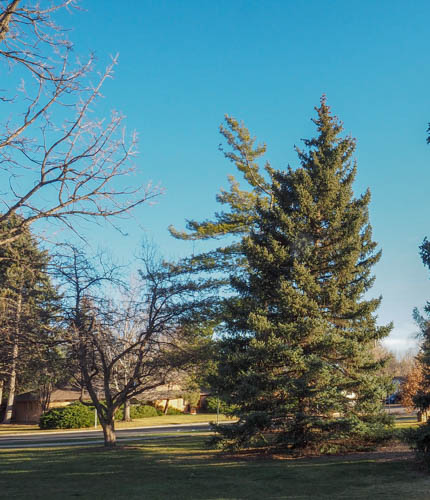
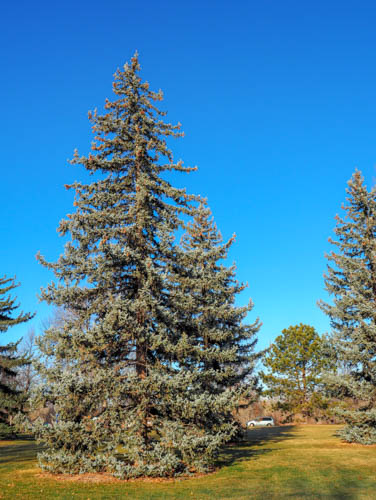
The Blue Spruce at the corner of Jackson and Mulberry

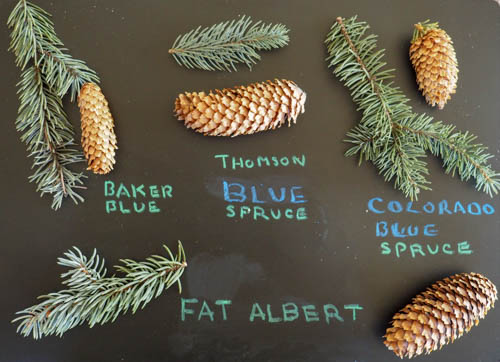
Colorado Blue Spruce  (Picea pungens or Picea pungens Engelm) was found on Pike’s Peak and later named by the father of the Engelmann spruce. In 1892 it was voted to be the state tree of Colorado, but this did not become official until the 1930s. There are possibly forty hybridizations of this tree, such as the Fat Albert (Picea pungens Fat Albert), the Baker Blue Spruce (Picea pungens Bakeri), and the Thomsen Blue Spruce (Picea pungens  Thomsen). All three varieties can be found in City Park. The Thomsen Blue Spruce is listed as a state champion tree, although this can’t be verified on the list of 2017 State Champion Trees. The Fat Albert variety was developed in the 1970s, meaning the tree in City Park can only be around 50 years old.

Colorado Blue Spruce, which are seen throughout most of the Rocky Mountain states, may reach 600 years of age. According to conifers.org the tallest Colorado Blue Spruce grow in the San Juan Mountains near Pagosa Springs and these trees include both state and national champions. The Blue Spruce is another tree often used as a Christmas tree. They are grown in the east for this purpose. Most sources identify the native range of this tree to be the southern Rockies, but the USDA site adds some eastern states, such as New York. Another USDA site on the internet posits these trees are actually “escapees” and not native at all. A blue spruce has been the capitol Christmas tree three times. According to Wikipedia, the National Christmas tree has been a living blue spruce since 1973.

Like the White Spruce and the Engelmann Spruce, the Blue Spruce is known by other names, including white spruce, silver spruce and water spruce. Spruce seem easy to identify as Picea, but deciding on which species/variety each belongs to is as confusing as their various names. There are some differences between their leaves and cones but even these are difficult for the casual observer to determine.

Spruces-1

There are two tagged Colorado Blue Spruce in the park, but I could only locate the tagged one on the NW corner of Mulberry and Jackson C163. The tagged tree belongs to a small group of conifers and is the spruce closest to Jackson Street, near an Eastern White Pine. You have to “walk into” the branches to find the identifying tag.

CO BLUE
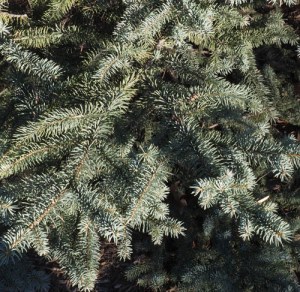
Branches of the Colorado Blue Spruce

To find the Thomsen Blue Spruce (C166),

Thomsen-1
Thomsen Blue Spruce

follow the sidewalk that runs along Mulberry Street. This tree is the first evergreen west of the signaled crosswalk, more or less across from 1413 West Mulberry. Cones can be seen near the top of the tree.

Thomsen-3-3
Close up of the needles on the Thomsen Blue Spruce

To find the Fat Albert D213, keep walking west and cross Sheldon Drive to the NW corner of Mulberry and Sheldon Drive. The tree is question is the spruce closer to the lake. The needles on the Fat Albert seem to be the stiffest and most prickly of the specimens collected and are very silvery-blue.

Fat Albert-2
The Fat Albert
Fat Albert (1 of 1)
Needles on the Fat Albert


The last tagged Picea pungens cultivar in the park is at the SW corner of Sheldon Drive and City Park, the other end of Sheldon Lake. The Baker Blue Spruce (D194) is next to the tagged Engelmann Spruce. 

Baker (1 of 1)
Branches on the Baker Blue Spruce
Baker-2
Baker Blue Spruce


Engelmann Spruce– A True Native of Larimer County

The oldest Engelmann Spruce is over 900 years old


PC070053
Engelmann Spruce

It seems to me one of the most confusing aspects of spruce trees is their many alternate names. One of the names for the Engelmann Spruce is white spruce, as well as silver spruce and the generic-sounding mountain spruce. At a glance, the various species look very similar, too. The Engelmann Spruce (Picea engelmannii) is a native of North America. Listed in Flora of Colorado (Jennifer Ackerfield, 2015) it is native to Colorado as well as Larimer County! Unlike the White Spruce written about last week, internet sources concur this one is a native and show its range being the western part of the continent, south to the New Mexico/Texas border and north to the British Columbia/Yukon border. Possibly the confusion with the white spruce is due to the two trees hybridizing? The Gymnosperm Database mentions that the oldest Engelmann spruce is in Colorado and has attained at least 911 years of age.

PB290008
White Spruce needles and cone on the left, Engelmann Spruce needles and cone on the right.

The fine needles on the twigs and branches of the Engelmann spruce are much more evenly spaced than those of the white spruce, reminding me of a bottle brush. From a distance, this is hard to distinguish. When examined closely, the spruce cones also have subtle differences; the ends of the Engelmann spruce cones appear to be toothed. Comparing the tagged park specimens, the cones of the Engelmann are also somewhat larger than those of the White Spruce. The Engelmann spruce is the second most common tree used for the Capitol Christmas tree with nine appearances since 1970.

The New York Times Style Magazine of December 3, 2017 short article “Chasing Pine” discussed a number of edible uses of conifers, including the historical spruce beer. Modern chefs make pine ice cream, pine aioli, and custard. Others use a spruce oil in drinks, Some sprinkle a spruce-sugar concoction on cookies.

PC070048
Engelmann Spruce bark

The Englemann Spruce listed on the tree guide (D193) is at the Southwest corner of City Park and Sheldon Drive.  You can access this corner by turning onto Sheldon Drive from Mulberry   and parking near the intersection with City Park Drive. That corner of the park is lined by deciduous trees on the eastern and northern edges. Numerous conifers form the south edge along the lakeshore. The marked tree sits in front of the larger spruces, between an Oakleaf Mountain Ash and a Baker Blue Spruce. It has a perfect conical Christmas tree shape.


December is for Christmas Trees and Our First is a Champion

A popular tree to decorate for Christmas

Every year trees are brought to the nation’s capitol to adorn the Capitol lawn, outside the Whitehouse, and sometimes in the interior of the Whitehouse. The National Christmas Tree has been displayed, cut or planted, in the President’s Park as well as other spots. This tradition started in 1923. The most common tree used is a variety of spruce.

Although the U.S. Capitol Christmas Tree tradition began before 1970, every year since then a different national forest has provided the tree. The White Spruce has been the tree of choice twelve times, the most of any single species. The tagged White Spruce (Picea glauca) in the City Park Arboretum near the intersection of City Park and Sheldon Drive is not only a native to Colorado, but a state champion tree. This tree probably does not call to mind a tree to decorate, though, as it is quite tall and somewhat spindly looking.

PB060067
The State Champion White Spruce

The USDA shows this species as having a very northern range, including Wyoming, but not Colorado. The Forest Service shows its range as even more restrictive. North American Trees (Preston and Braham, 2002) appears to agree with the USFS. The map on the Gymnosperm Database  also shows the distribution as very northern, mostly Canada, but goes on to list a number of states where the tree is native, again Wyoming but not Colorado. North American Trees says these trees do not reach maturity until 250-300 years and the Gymnosperm Database says the oldest tree, growing in the Yukon, is over 668 years old.

White spruce lumber has been used for sounding boards in violins and other instruments, for pulp, general construction, and Christmas trees. The National Christmas Tree Association suggests their short needles make them ideal for hanging ornaments.  I examined the branches of the tree I bought for my house this year, and I’m thinking it very well may be a white spruce.

The tree is significant for wild life and its roots were used by Native Americans to weave baskets and bind canoes. A British Columbian website includes making snowshoes and bows in its uses. Resin was turned into a gum to stick arrowheads to arrows. Like most of the other trees reported on thus far, this one, too, has medicinal properties, including antiseptic, respiratory, and wound care. It has also been investigated for its relation to diabetes!

PB290008
The needles and cone of the White Spruce

This specimen (A94) can be located by studying the tall conifers at the Northeast corner of City Park and Sheldon Drive. There are ten trees on this corner, but only two of them are conifers. The more northern of the two is the tagged tree, although I suspect the second tree is also a white spruce.

PB060055
White Spruce bark


The confounding Mountain Ashes

Mountain ashes are not true Ash trees and are not subject to ash borer.

First, mountain ash trees are not really ash trees. True ash trees are in the olive family while mountain ash trees are in the rose family. There are five types of mountain ash listed on the Arboretum guide and I’m discussing them all here, partly because there isn’t much to say about specific cultivars. 

We first located the Oakleaf Mountain Ash (Sorbus x  thurgingiaca Quercifolia). This might be the most local of local trees as it was cultivated in Cheyenne! This particular tree seems both similar and different from those discussed below. It has similar slits in its bark, yet these are more vertical, not horizontal. There is a slight sheen to the bark and it appears thinner than the bark of other trees. The leaves are not similar to the other mountain ashes, but resemble oak leaves.

Oak Leaf Mountain Ash
PA270010
Oakleaf mountain ash leaves in fall

A76 is located near the pottery studio (corner of S. Bryan and Oak Street.) 

The other four Sorbus trees are at the other end of Oak Street and have leaves that resemble “real” ash trees.

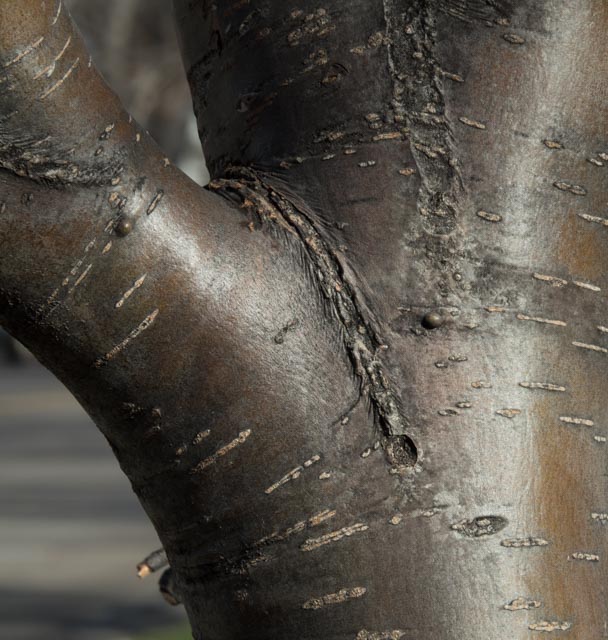
The American Mountain Ash (Sorbus americana) is native to the Eastern part of the continent, but has been introduced to most of the rest of the continental US, including Colorado. B106 is across the street from 1334 W. Oak Street. The bark of this small tree is reddish with a metallic sheen. There are horizontal lines that resemble healed cuts across the bark and visible reddish berries (pomes) in the upper branches. Native Americans such as the Algonquin and Ojibwa ate the berries from this and related species. 

American Mountain Ash bark
American Mountain Ash bark. Notice the metallic sheen.

The European Mountain Ash  (Sorbus aucuparia) has been introduced to much of the northern part of North America. In England these are referred to as Rowans and the berries are made into jams and sometimes wine. There seems to be controversy about how tasty these are as many say they are bitter and must be cooked or undergo numerous freezes on the tree before they are edible. According to the source above, the berries are a good source of vitamins A, C and niacin. The Rowan also has a place in many European mythologies and is considered by some to have magical powers. Its wood has been made into walking sticks and spinning wheels.

It appears there are two cultivars of the European Mountain ash in City Park. B109 Cardinal Royal Mountain Ash (Sorbus aucuparia Cardinal Royal) is near the Kentucky Coffee Tree, across from 1316 West Oak. The bark of this tree is very grey-green, more reddish at the base.

PB150044
Cardinal Mountain Ash bark

The other cultivar is the Russian Mountain Ash (Sorbus aucuparia Rossica.) B102 is across from the intersection of McKinley and Oak. As is noted in the write-up referenced above, this tree, with its yellow-green tinged skin, seems to have more noticeable berries. 

PB150030
Russian Mountain Ash trunk
PB190051
This straggly tree IS NOT a mountain ash at all but a linden!

The last mountain ash tree in City Park is the Showy Mountain Ash (Sorbus decor), which once again is native in the northeastern part of the continent where it is also known as the Northern Mountain Ash. I made many trips across the street to locate this tree. What I finally settled on as B103 wasn’t particularly showy and was very difficult to find. Possibly this is because it is not tagged, and it is also not very large, which might have an effect on some of its notable properties, such as large, showy berries. See for yourself. Would you have known this was a showy tree?

UPDATE 3/23/18: Today I spoke with City Forestry Specialist, Molly Roche. No wonder I had such a difficult time finding the Showy Mountain Ash. It ISN’T THERE. After it was discovered not thriving, it was removed and replaced with a Legend Linden. THAT is what the not particularly showy tree actually is! 


A Champion Larch in City Park

The Colorado Tree Coalition publishes a list of state championship trees. It also has a map of a tree tour of notable Ft. Collins trees.http://coloradotrees.org/wp-content/uploads/2016/06/Notable_FtCollins.pdf

PB060012
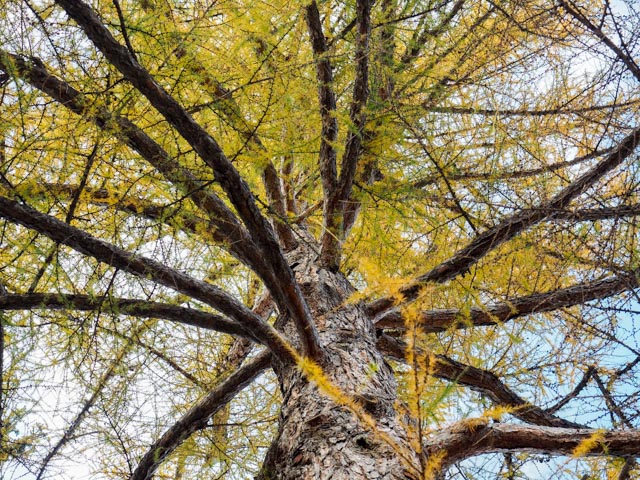
The Championship Larch on Jackson Street, November 2017

Yes, we have a State Champion tree in City Park. The European Larch is an impressive tree and once you know what it looks like, easy to find. This particular tree is hidden in with a bunch of conifers. What distinguishes a larch from other conifers? It’s deciduous and loses it leaves, which the uninitiated would call needles. The big tree isn’t the only example of a larch in the park. There is a recently planted–in the last ten or fifteen years—larch just behind the Kentucky Coffeetree. This second tree is tall and spindly while the champion tree is tall, sturdy, and spooky looking.

The distribution of the European larch, which is an introduced, non-native tree, is, as you may have guessed, the eastern part of the US and Canada. Its range is less than the many other trees reported on so far. North American Trees reports European Larch “is planted and sometimes escapes”! According to the 1932 pamphlet European Larch in the Northeastern United States by Stuart Hunt, larch was introduced into England in 1629 and into the US in the mid 1800s, in both cases for lumber.  If you are a fan of the Great British Bake-off, you might have noticed a larch outside the baking tent. The largest larch in the world may be one in Switzerland which also may be 900 years old! It makes our larch look like an anemic relative by comparison.

Many authors report larch wood is fire resistant and was used in Roman ship and bridge building for that reason. Current uses include utility poles, veneer,  boat building, furniture, and fencing. The pitch can be tapped to be used as a varnish and for waterproofing boats and roofs. The bark has been used medicinally or ground and added to flour.  Another source mentions Siberians collected the leaves, fermented them and used them as a salad in winter.

The larch also has a place in mythology and pagan rituals, as well wand material in Harry Potter. Larches may be planted for cremation ceremonies, used to ward off evil spirits or burned to inhale the smoke and promote visions.

PB060019
Looking up through the branches the tree truly does look magical.

To find our champion Larix decidua (E117) park near the corner of Jackson and Oak. The five-way corner at the NE entrance to the park forms a triangle on the S side of the stone entrance with the row of trees being one side. In the center of these conifers is the Larch. It is probably easiest to locate when its leaves are yellowed and before they all fall, making it a good tree to find in the late fall/early winter.  The tree is across from 210 Jackson. 


Paperbark Maple- An Endangered Tree

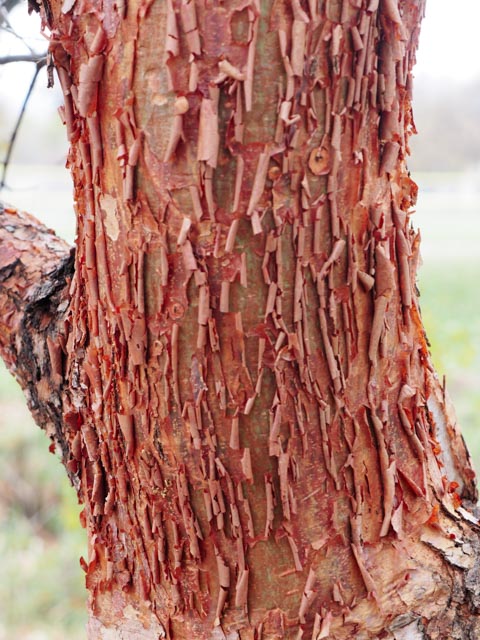
Winter interest in the beautiful bark.

P9290044
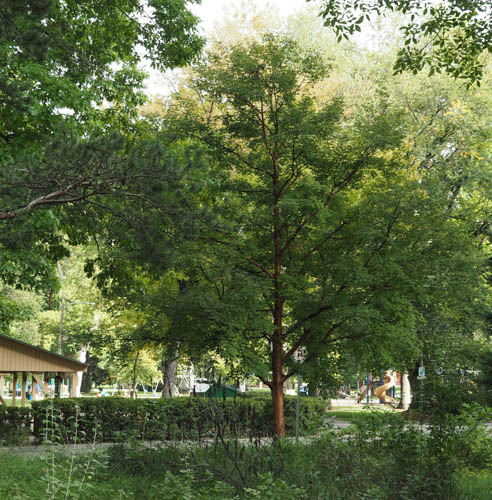
Paperback Maple

The Paperbark Maple, Acer griseum, is not listed in North American Trees, nor does the USDA have a page for its range. The University of Florida, though, shows it growing in most states except the most southern, including Florida! The tree is native to central China, although according to Plants of the World Online it is endangered. Although the trees are available from nurseries and grow in zones 4-8, their primary use is ornamental. Although the tree was introduced into Europe in the early 1900s, little seems to be written about any uses of the leaves, bark, or lumber. Most merely state it is lovely to look at in the garden.

P9290032
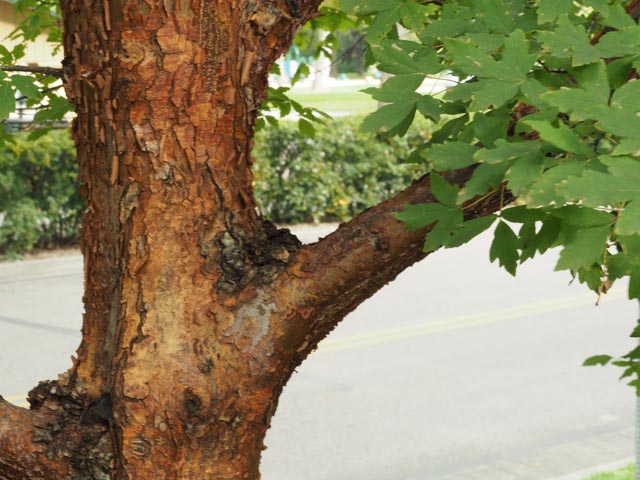
Leaves against the cinnamon colored bark of Acer grissom

Due to its distinctively colored bark, this tree is identifiable and showy even in winter.

To find E57search S. Bryan Street between Oak Street and City Park Drive. The tree is on the strip between the road and the ditch, across from the large shelter S of the Pottery Studio. 

PA300011
Close up the curling red bark. Paperback Maple


Gingko Tree–Most Unique Tree in the World?

A tree that hasn’t changed in 200 million years

I had no idea. Of course I’ve been bombarded with ads for the wonderful  memory properties of gingko biloba although I never tried it. I didn’t even know it was a tree, nor did I know it grew not only in the United States but right in our own City Park. My tree course mentioned there was a single species, family, and phylum for this tree, but it wasn’t until I started to research it that I learned the tree is a living fossil and hasn’t changed in over 200 million years!
According to the USDA map, the Ginkgo tree was introduced to the US. It is not widely distributed throughout the states, but seems to be very popular in New York and four or five other Eastern states.  Mississippi also has an affinity for this tree. The Gingko appears to be able to withstand the stress of city living, which might be one of the reasons they are very popular in New York City. According to one source, there are 21,611 Ginkgo trees in the city, a map or which can be seen here.

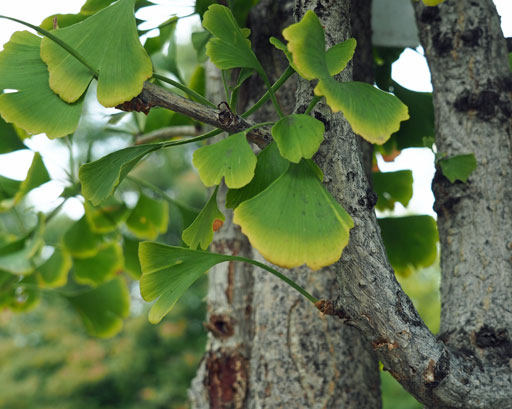
Once you see a Gingko leaf with its fan-like shape, the trees seem easy to identify. Although  there is only one tagged specimen in the park, I’m sure I found a leaf near a denuded tree very far away, too.

P9290012
Fan-shaped Gingko leaves as they start to turn in the fall.

Gingkos are often called the oldest trees or most unique plant on earth as they are the only species in their class, have not changed much in 200 million years, and have no close relatives. Peter Crane, Dean of the Yale School of Forestry and Environmental Studies, has written a book about the tree, Ginkgo (Yale University Press, 2013) and was interviewed about the tree here.

I did not encounter any seeds from the one tree in City Park, but they are said to be both messy and smelly, producing a compound that is common in rancid butter. Crane says they smell like vomit. Due to this, usually only male trees are planted. I’m assuming this tree is male, although the same source indicated that the trees don’t produce seeds until they are thirty-forty years old.
Similar to the tenet “form follows function” of the Arts and Crafts and other architectural movements, the herbal uses of this tree seem to relate to its biological history. Most of the medicinal uses  relate to many problems associated with aging, such as heart trouble, macular degeneration, tinnitus, as well as it best known use as an herb to improve memory. Components of the plant have long been used in Chinese, Japanese, Indian and Indonesian medicine.

For those of you who might like to explore more about this fascinating tree, there is an all-encompassing blog that includes a history of some of the most interesting Gingko trees from around the world, the use of the leaves in art, and even a Gingko lullaby.

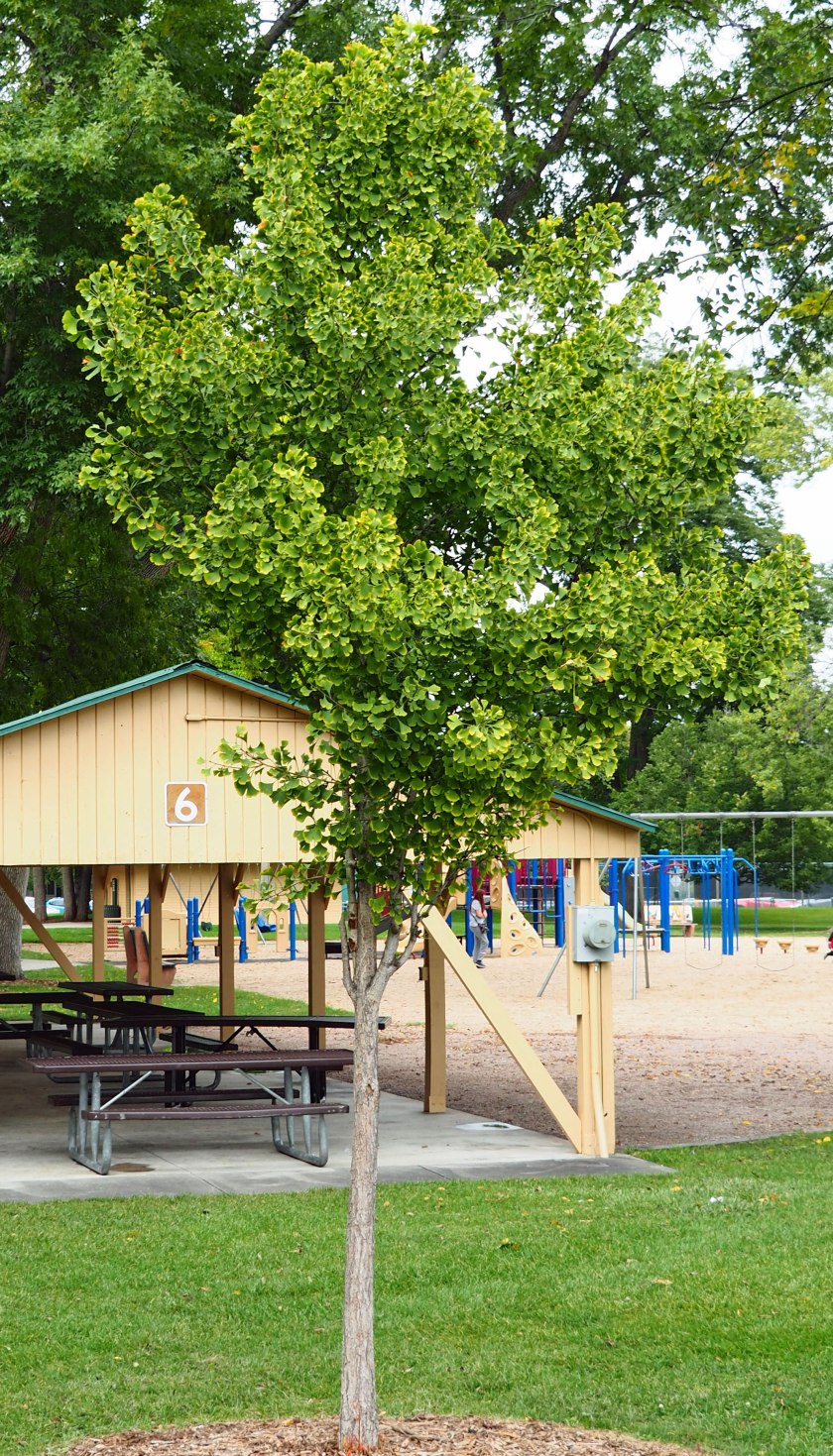
To find this tree, also known as the Maidenhair tree, look for A72 on the map. Basically it is across from the entrance to City Park Pool, right in front of the picnic shelter #6 on the corner of S. Bryan and City Park Drive.  Without its leaves, it looks much smaller than this picture!P9290007-2